
Published : 2026-05-04
When people think of Chinese canals, the ancient Beijing-Hangzhou Grand Canal—the world's longest—usually comes to mind. However, in the 21st century, China is embarking on several "project of the century" scale canals that are either under construction or in the planning stages.
One of the most significant is the Pinglu Canal, scheduled for completion in 2026. But where exactly is it, and why does it matter so much?
Pinglu Canal|Extensive land networks: Are canals still necessary?
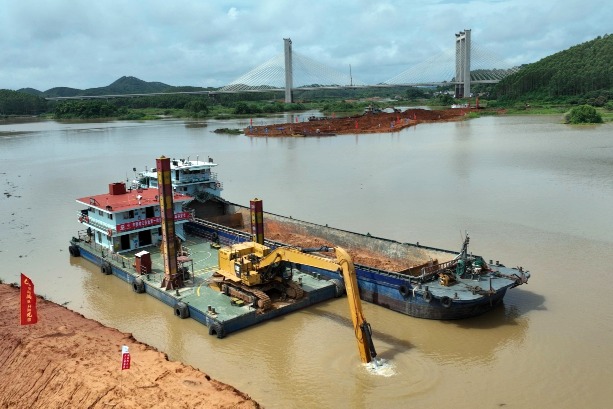
A canal refers to a man-made waterway, mainly used to connect different bodies of water, or to serve as a shortcut for water transport, shortening shipping routes.
But many people may wonder, given that China's roads and railways are now highly developed, is there still a need to build canals? Does water transport still have its advantages?
Some Chinese Mainland media have pointed out that the cost of water transport is 1/2 that of rail transport, 1/5 that of road transport, and 1/20 that of air transport. Moreover, water transport has a large capacity, low energy consumption, and low pollution, making it very suitable for bulk goods such as steel, or for goods that are not time-sensitive.
At the same time, water transport has long been a weak link in China's transport investment, and its role in the logistics network has room for improvement.
Therefore, building more convenient water transport channels can not only drive investment but also benefit the development of related regions.
It was mentioned earlier that canals can shorten the distance of water transport routes, and the role of the Pinglu Canal is particularly prominent in this regard.
Pinglu Canal|Guangxi's lack of river-to-sea connectivity hinders transport
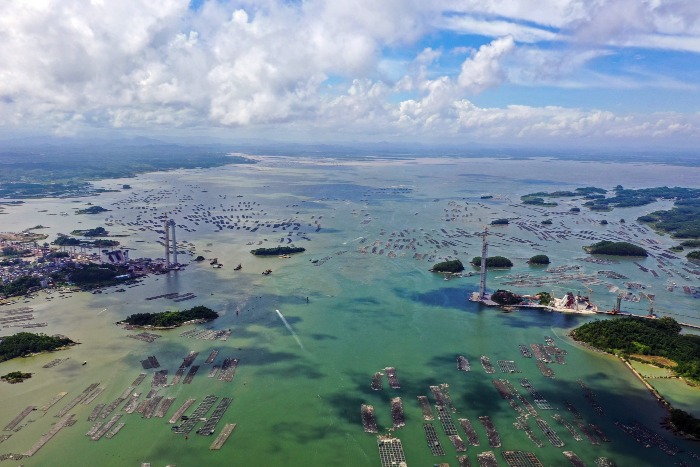
Guangxi Zhuang Autonomous Region is rich in water resources, and the Xi River (西江) basin has a large volume of inland shipping cargo. But if you look at a map, you will find that although Guangxi is a coastal provincial administrative region and the Xi River is mostly within Guangxi's territory, the river and the sea are not directly connected.
For cargo departing from the middle and upper reaches of the Xi River to go to sea, if it needs to pass through Qinzhou Port (欽州港) in Guangxi's Beibu Gulf (北部灣), it needs to be transferred to rail or road transport, which is time-consuming and inefficient.
Therefore, more cargo ships would rather travel east along the river to deliver goods to the ports in Guangdong's Pearl River Delta, such as Guangzhou Port, to reach the sea.
If the Xi River had the Pinglu Canal as a sea-bound channel in Guangxi, the situation would be very different.
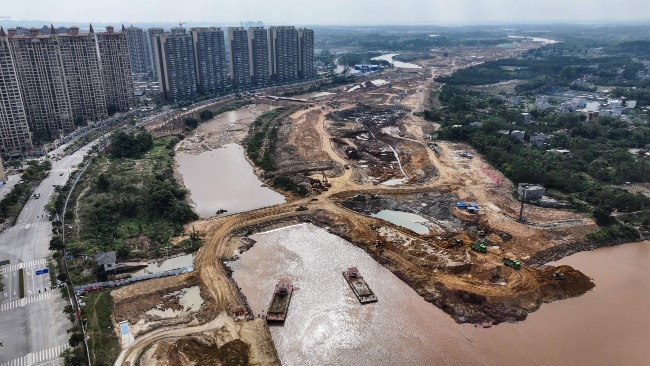
Construction on the Pinglu Canal began in 2022. It is the first river-to-sea canal in the People's Republic of China (PRC). Some media even believe that this is China's largest canal project since the Beijing-Hangzhou Grand Canal.
Pinglu Canal|Reaching the sea via Pinglu Canal saves 560 km of voyage
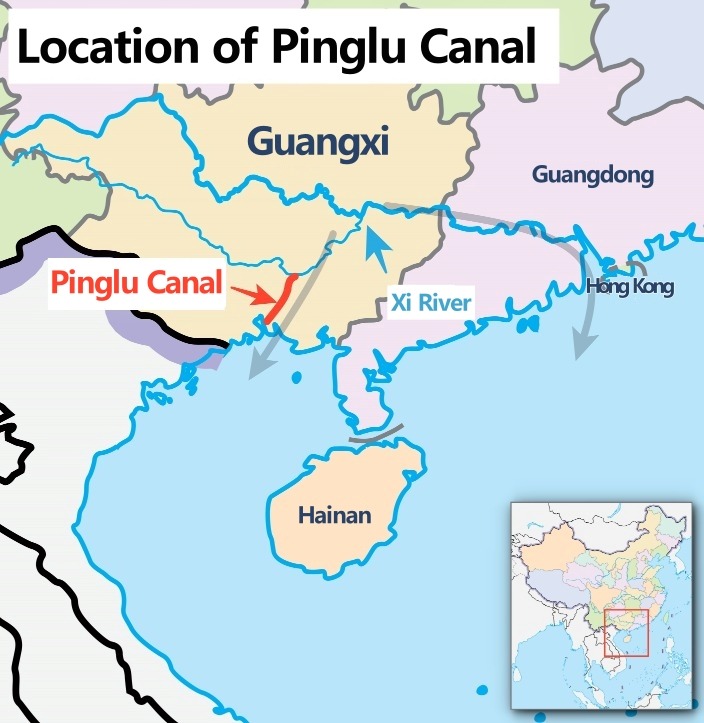
The Pinglu Canal (平陸運河) begins at the Pingtang River (平塘江) estuary of the Xijin Reservoir on the Yu River (鬱江)—located in Hengzhou (橫州), under the jurisdiction of Nanning, the capital of Guangxi.
It stretches to the town of Luwu (陸屋) in Lingshan County, Qinzhou City, before following the Qin River (欽江) into the Beibu Gulf. The name "Pinglu" (平陸) is a portmanteau derived from Pingtang (平塘) and Luwu (陸屋).
The Pinglu Canal has a total length of 134.2 km, equivalent to the straight-line distance from Hong Kong to Guangzhou. The canal has a drop in elevation of 65 metres, about the height of a 20-storey building, so three cascade hubs, Madao (馬道), Qishi (企石), and Qingnian (青年), had to be established along the route to regulate the water level through ship locks.
With the help of the three sets of ship locks, the entire Pinglu Canal meets the Class I inland waterway standard and can accommodate 5,000-tonne ships.
After its completion, the Xi River will have a sea route in Guangxi, and ships from the middle and upper reaches of the Xi River will be able to travel directly to the Beibu Gulf via the canal, and the water transport distance will be reduced by about 560 km compared to going out to sea via Guangzhou Port.
Pinglu Canal|Saving 5.2 bln RMB in transport costs for regions along the route annually

If cargo ships sail directly from the inland river ports of the Xi River to Southeast Asian countries such as Vietnam, the time saved will be even more considerable.
According to official data, the total investment in the Pinglu Canal amounts to 72.7 billion RMB, but it can save more than 5.2 billion RMB in transport costs for regions along the route annually.
The Pinglu Canal will also become the shortest, most economical, and most convenient sea access channel for Southwest China, driving the resource advantages along the New International Land-Sea Trade Corridor (西部陸海新通道) and transforming them into economic development advantages.
The New International Land-Sea Trade Corridor is a flagship project of the Belt and Road Initiative (BRI), encompassing nine provincial administrative regions and cities across the hinterland of Western China.
As a vital transport, logistics, industrial, and trade corridor, it integrates land and sea transport to link international and domestic markets. It connects to the Silk Road Economic Belt in the north, joins the 21st Century Maritime Silk Road in the south, and operates in synergy with the Yangtze River Economic Belt.
Pinglu Canal|3 world-class inland ship locks
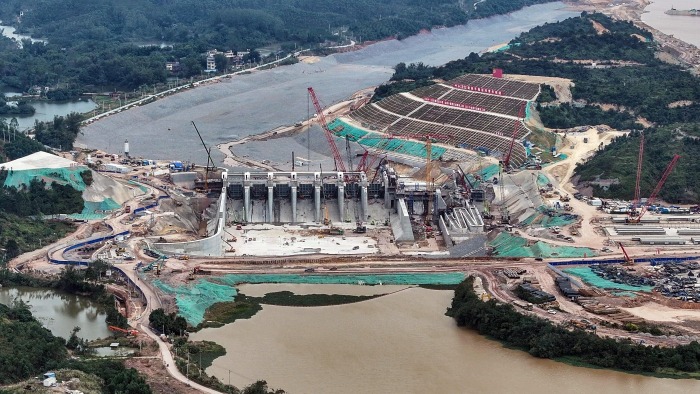
Finally, to add some more information, it was just mentioned that the Pinglu Canal can accommodate 5,000-tonne ships, which you may not have much of a concept of.
According to media reports from Chinese Mainland media on Yangtze River water transport, a 5,000-tonne inland river ship is about 100 metres long, and its carrying capacity is equivalent to 100 railway wagons.
In addition, the three sets of ship locks on the Pinglu Canal are world-class.
For example, the ship lock at the Madao Hub, the water area for ships to moor inside the lock chamber reaches 300 metres in length and 34 metres in width, making it the largest water-saving inland ship lock under construction in the world.
Furthermore, at the Qishi and Madao hubs, the lock gates take only about one minute to open and a mere 30 seconds to close. These facilities can accommodate six 5,000-tonne vessels per hour, making them the fastest-operating water-saving ship locks in the world.
So-called "water-saving locks" feature adjacent storage basins that temporarily hold a portion of the water discharged during the emptying process.
When the lock chamber needs refilling, this stored water is fed back in. Such a design significantly reduces the overall water consumption of the lock system.
Further Reading: 2,000km Zhejiang-Jiangxi-Guangdong Canal: GBA's direct access to Yangtze River Delta